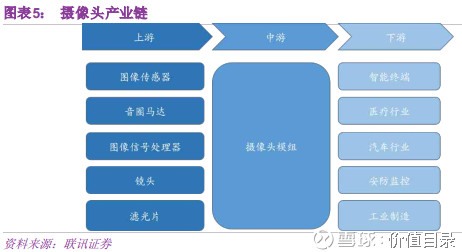
Cameras capture still images and video. A lens projects light onto an image sensor, which converts it to an electrical signal. After analog-to-digital conversion, the image signal processor (ISP) processes the data for display. Lenses, sensors and ISPs are key components; motors, filters, circuit boards and supports also form part of the supply chain.
Module assembly connects component suppliers to phones, tablets, computers, conferencing, surveillance, vehicles, industrial equipment, entertainment and medical devices. Packaging was concentrated in mainland China, Taiwan, Japan and Korea. High investment and increasing customer concentration favoured larger manufacturers, including O-Film, Sunny Optical, Q Technology and Truly.
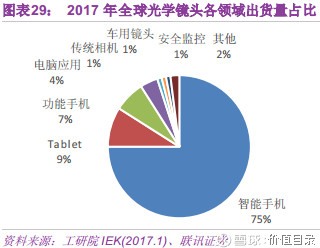
Mobile devices represented around 90% of optical lens shipments in the figures cited, with smartphones alone accounting for 75%. Computer products accounted for 4%, traditional photographic equipment 1.3%, automotive and security applications around 1–2%, and machine vision, VR/AR, projection and other specialist uses about 2%. Dual cameras were expected to drive growth as conventional digital cameras declined. Largan led the market, and Sunny Optical had entered the high end. Phone lenses were becoming smaller, thinner and less expensive, with hybrid designs seen as a possible next step.
The article forecast compound annual growth of 10.5% in CMOS image sensors from 2016 to 2022, driven by dual cameras and 3D sensing. Sony led the field. The acquisition of OmniVision provided a route into the leading group, while GalaxyCore also had a presence.
Global mobile voice-coil motor consumption reached 1.49 billion units in 2016. The article cited a 17.1% compound growth forecast for 2016–2020. Chinese suppliers entering from 2013 developed closed-loop, optical stabilization and high-resolution motors, challenging Japanese and Korean suppliers. Dual cameras and higher resolutions increased demand for blue-glass infrared-cut filters, while 3D sensing created demand for narrow-band filters. O-Film and Crystal-Optech were named as leading suppliers.
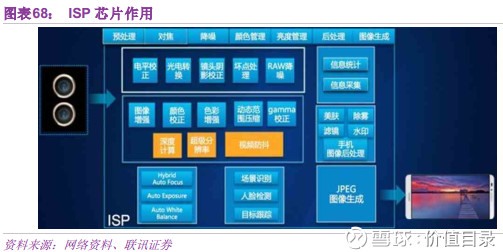
ISPs perform linear correction, noise reduction, defective pixel repair, colour interpolation, white balance and exposure correction. Integrated ISPs predominated, with some high-end phones using dedicated chips. Software became an important differentiator as dual cameras and wide-aperture effects increased processing demands. Huawei integrated an ISP into its application processor.
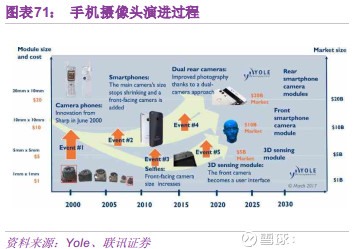
The article anticipated a shift from two-dimensional imaging toward three-dimensional sensing, recognition and interaction in autonomous driving, AR and robotics. Its historical investment commentary identified lens, module, filter, chip, motor and equipment manufacturers as potential beneficiaries and named Sunny Optical (02382), O-Film (002456) and Crystal-Optech (002273).